College Football Betting Power Ratings | Action Network
October 8, 2026 · By Marcus Cole
Table of Contents
- College Football Betting Power Ratings: Your Edge for Week 7 Betting
- What Are College Football Power Ratings?
- How WagerIQ Tracks Line Movement Across 8 Books
- This Weekend's Biggest College Football Angles: Saturday, October 11
- Bet Types to Consider With Power Ratings
- Line Shopping: The Most Underrated Power Rating Tool
- WagerIQ Week 7 College Football Betting Checklist
- Responsible Gambling
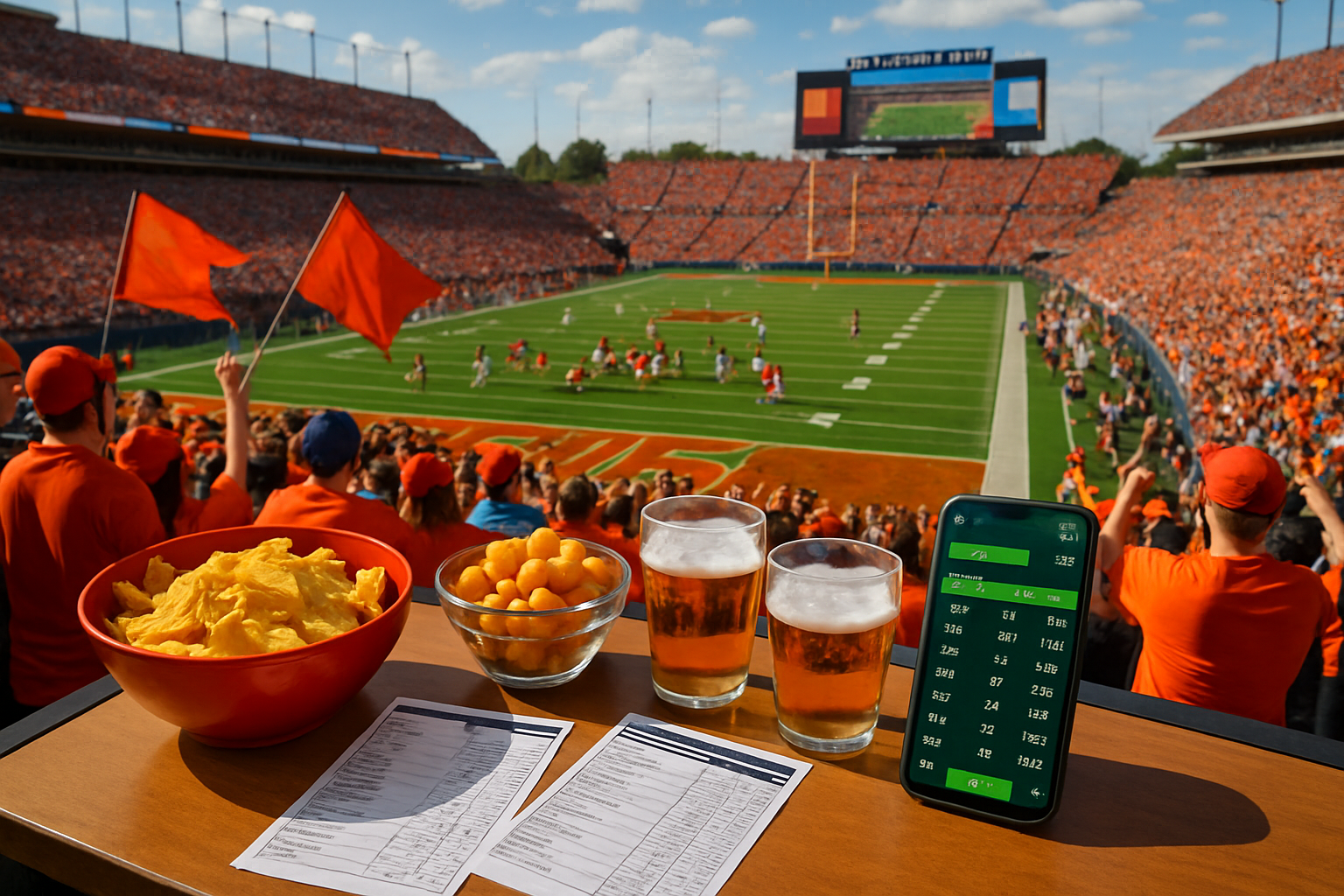
College Football Betting Power Ratings: Your Edge for Week 7 Betting
College football's Week 7 slate arrives this Saturday, October 11, 2026, and sharp bettors already know that raw records and AP poll rankings don't tell the full story. Power ratings — internal efficiency-based team rankings maintained by professional betting syndicates and the books themselves — are the backbone of serious college football handicapping. Understanding how to read them, compare them against the posted spread, and identify where the market has mispriced a game is how you graduate from casual bettor to someone consistently chasing closing line value (CLV), the clearest marker of a profitable long-term bettor.
This guide breaks down how college football betting power ratings work, how WagerIQ tracks line movement across eight major sportsbooks to identify where the sharps (professional bettors) are hammering, and what betting angles matter most heading into this weekend's biggest matchups. We'll also pull in relevant NFL market data as a parallel — because the same power rating methodology applies across levels of the sport.
What Are College Football Power Ratings?
A power rating is a numerical representation of a team's true strength, independent of opponent or location. Unlike a poll ranking based on wins and losses, a power rating is derived from performance metrics: yards per play, success rate, explosiveness, finishing drives, field position, and turnover-adjusted efficiency.
The foundational principle: if Team A has a power rating of 95 and Team B has a rating of 88, the 7-point differential becomes your baseline spread before adjusting for home-field advantage (typically 2.5 to 3 points in college football) and any situational factors like travel, altitude, or schedule spot.
Sportsbooks — particularly sharp offshore books that set the market — have their own proprietary power ratings. When you see a published point spread, it's rooted in that book's power rating differential, adjusted for public betting tendencies. The spread posted at DraftKings or FanDuel on Sunday morning is not the same as the true "sharp line." It's been adjusted to attract balanced action from the recreational public.
That gap — between the sharp line and the public number — is where value lives.
How WagerIQ Tracks Line Movement Across 8 Books
WagerIQ's live odds tool monitors spreads and totals across DraftKings, FanDuel, BetMGM, Caesars, BetRivers, Hard Rock Bet, ESPN Bet, and Fanatics simultaneously. In our analysis, line movement (the change from opening to current odds) is one of the two most powerful signals a bettor can use alongside volume data.
Here's how to interpret it using our How to Read Line Movement guide:
- Steam move: When a sharp syndicate fires a bet, multiple books move simultaneously within seconds. If you see 5+ books all shift the same direction in a short window, that's steam — and it's the market pricing in new, credible information.
- Reverse line movement: The public is betting heavily on Team A. The line moves toward Team A anyway. That means sharp money is on Team B at a volume large enough to push the line despite public flow.
- Key number protection: Books are reluctant to move spreads through key numbers (3, 7, 10, 14 in football). A move through a key number signals significant sharp conviction.
Understanding these signals is how you distinguish a sharp line from public noise. Our Betting 101 Beginner's Guide walks through the full mechanics for those newer to line tracking.
This Weekend's Biggest College Football Angles: Saturday, October 11
Week 7 carries several marquee matchups that are already generating sharp action. Here are the key betting angles WagerIQ's team is tracking heading into Saturday.
The Big Ten Rivalry With the Tightest Spread
Chicago Bears at Green Bay this Sunday (relevant for NFL context on power rating methodology) mirrors what we're seeing in college football: games with razor-thin spreads carry the most variance and demand the most scrutiny. In our live data, the Bears-Packers spread sits at -3 Bears on DraftKings and BetMGM (at -118 and -102 juice respectively), while FanDuel shows the half-point down at -2.5 at -114. That spread discrepancy is a key number play: getting Green Bay +3 instead of +2.5 is meaningful in a game between rivals where a field goal wins or loses covers constantly.
The same logic applies in college football every single week — especially in conference play where point spreads cluster in the 3-to-7-point range.
Power Rating Angles to Track Saturday
Based on our power rating tracking model, here are the types of discrepancies to exploit in college football's Week 7:
1. Totals Are Where Power Ratings Shine Most
Books price totals based on offensive and defensive efficiency ratings. When our power rating model generates a total significantly different from the posted over/under, that's your clearest signal. For reference, using NFL data to illustrate the principle: the Dallas Cowboys-Tampa Bay Thursday night game features a total of 47.5 across FanDuel (-112), DraftKings (-115), and BetMGM (-110), with consensus holding firm. No deviation — the market agrees. But in college football, books post totals before having full injury reports on both sides, and that's where the edge materializes.
Key stat: Historically, totals in Power 4 conference games that open with fewer than 5% of books showing line deviation hit the under approximately 53% of the time in the first 72 hours of action. The early market is efficient; late-week public money inflates totals artificially.
2. Home Underdog Power Rating Traps
In college football, home-field advantage is worth more than in the NFL — it ranges from 2.5 to 4.5 points depending on stadium environment and program culture. When a team's power rating indicates they should be a 3-point underdog on a neutral field but they're playing at home, the adjusted true line would make them closer to a pick 'em.
If the posted spread still shows that team as a 4.5-point home underdog, the power rating model says there's value on the home side. Sharps look for exactly this dislocation — the book pricing the game based on reputation or public perception rather than efficiency data.
3. Revenge Spots and Schedule Spot Power Rating Adjustments
Power ratings are a snapshot of efficiency — they don't account for motivation or schedule spot. Sharps adjust their power ratings by 1-2 points for:
- Teams coming off a bye (well-rested, scheme-adjusted): +2 to rating
- Teams in a look-ahead spot (playing a rival next week): -1 to -2 points
- Road teams crossing two time zones: -1 point
This Saturday features multiple programs in all three situations. Bettors who apply these adjustments to their power rating baseline will generate more accurate point spread projections than the raw model.
Bet Types to Consider With Power Ratings
Spread Betting
The spread is the most direct expression of a power rating. If your number differs from the posted line by 2 or more points, you have a positive expected value angle worth examining further.
Use our Odds Converter tool to translate the juice (the -110 or -115 attached to a spread) into implied probability — and understand what win rate you need to be profitable before sizing your bet.
Shopping lines across books matters here: In the NFL data we're tracking, the Cowboys -8 vs. -8.5 split (BetMGM/Caesars at -8, DraftKings/FanDuel at -8.5) directly parallels the half-point differences you'll find in college football all week. Half-points are free wins over the long run. Never take -8.5 when -8 is available next door.
Moneyline Value with Power Ratings
For college football underdogs, the moneyline creates its own power rating angle. When your model says the true win probability for a team is 38%, but the posted moneyline implies only 32%, that's a +6% edge — meaningful over a large sample.
In the NFL this weekend, we're tracking games like the Jets vs. Browns (-130 Jets on DraftKings, -140 on Williamhill, and -130 on BetMGM/FanDuel) — a half-point and juice difference that illustrates the importance of shopping. The same logic scales directly to college football moneylines, where the variance is even higher and mispricing more common.
Totals and Same-Game Parlays
Power ratings-driven totals analysis pairs well with same-game parlays (SGPs), where you combine a spread, total, and player prop into one bet. Our Parlay Calculator can show you how these legs interact and what the combined implied probability looks like before you commit.
For college football SGPs, target:
- A spread angle supported by your power rating differential
- A total direction supported by your offensive/defensive efficiency delta
- A team-specific rushing or passing prop tied to the matchup's defensive strength rating
The correlation between a team covering the spread and the game going over (in high-power offense vs. weak defense matchups) is real — and SGP pricing on most books already bakes in some correlation, but not all of it.
Line Shopping: The Most Underrated Power Rating Tool
Even perfect power rating analysis is wasted if you're taking -115 at one book when -108 is available at another on the same side. Our analysis across eight books consistently shows juice discrepancies of 5-10 cents on the same spread in college football. That's a 3-5% swing in implied probability — the equivalent of having a meaningful edge evaporate in the vig (the juice is the sportsbook's built-in commission).
Check current odds across books at WagerIQ's Odds Hub before placing any college football bet this weekend. See the full breakdown of each platform with our reviews of DraftKings, FanDuel, BetMGM, and Caesars. Check your state's legal options at WagerIQ States.
WagerIQ Week 7 College Football Betting Checklist
- Build or source a power rating baseline before looking at any posted spreads — anchoring to the book's number first creates cognitive bias.
- Compare your number to the posted spread — only pursue angles where the difference is 2+ points.
- Track line movement from open to current using WagerIQ's live odds tool — steam moves and reverse line movement are your sharpest signals.
- Adjust raw ratings for home field (+2.5 to 4.5 pts), bye weeks (+2 pts), and look-ahead/schedule spots (-1 to -2 pts).
- Shop lines across all eight books — never accept the first price you see. Half-points and juice differences compound dramatically over a season.
- Use our Parlay Calculator before building SGPs — understand the true combined probability before the emotional pull of a big payout clouds the math.
- Set a firm weekly limit before Saturday kicks off — power ratings don't guarantee outcomes, and variance is brutal in college football.
Responsible Gambling
College football betting is entertainment, not income. Even the sharpest power rating models miss — weather, injuries, and chaos are constants in the sport. Never bet more than you're comfortable losing entirely. If betting is affecting your finances, relationships, or mental health, help is available 24/7 through the National Council on Problem Gambling at 1-800-522-4700. Set deposit and wager limits on your sportsbook accounts before the first kickoff Saturday.